Real-World Prompt Calibration Examples and Workflows
Real-World Prompt Calibration Examples and Workflows
Last Updated: March 2026
Instead of relying on trial and error, prompt calibration uses a systematic approach to refine prompts. By clarifying intent, organizing instructions, and expanding context, calibrated prompts guide AI systems toward more accurate and useful responses.
As artificial intelligence becomes more integrated into everyday workflows, prompt calibration is emerging as a foundational skill for interacting effectively with AI.
Large language models such as GPT, Claude, and Gemini respond directly to the prompts they receive. The quality of the output depends heavily on how clearly the prompt communicates the desired outcome.
A vague or poorly structured prompt can produce incomplete, inconsistent, or misleading results.
For example:
Unstructured prompt
Write about climate change.
Structured prompt
Act as a climate policy analyst. Write a 1,000-word article explaining three economic impacts of climate change on coastal cities, including real-world examples and supporting data.
The second prompt provides clearer instructions and context, leading to far better output.
Prompt calibration focuses on creating prompts that consistently guide AI systems toward the intended result.
Many prompts fail because they lack structure and clarity. Common issues include:
Vague intent
The prompt does not clearly state what outcome is expected.
Insufficient context
The AI lacks the background information needed to produce meaningful output.
Unclear instructions
The prompt does not specify format, depth, or perspective.
Shallow prompts
The prompt asks for a result without providing enough detail for deeper reasoning.
Prompt calibration addresses these problems by refining the prompt so the AI system receives clear guidance.
Prompt calibration can be understood through five key layers that influence how AI systems interpret prompts.
Intent
The outcome the prompt is trying to achieve.
Archetype
The role or perspective the AI should adopt, such as analyst, teacher, researcher, or editor.
Structure
The organization of instructions, context, and constraints.
Depth
The level of detail, reasoning, and explanation requested.
Calibration
The process of refining and improving the prompt to produce more reliable results.
Together, these layers form the Prompt Calibration Framework.
A calibrated prompt typically follows a simple process.
Step 1 – Define the intent
Identify the specific outcome you want from the AI.
Step 2 – Select an archetype
Choose the role or perspective that best fits the task.
Step 3 – Structure the prompt
Clearly organize instructions and context.
Step 4 – Increase depth
Add details that guide the AI’s reasoning and analysis.
Step 5 – Refine and calibrate
Adjust the prompt to improve clarity, precision, and consistency.
This process transforms prompting from guesswork into a repeatable practice.
Uncalibrated prompt
Write about the future of renewable energy.
Calibrated prompt
Act as an energy policy researcher. Write a 1,200 word analysis of three major trends shaping the future of renewable energy, including technological advances, economic factors, and policy developments.
Explain the implications for global energy markets and include examples from recent industry developments.
The calibrated prompt provides clear instructions, structure, and depth, producing a far more useful response.
Prompt engineering focuses on writing prompts that produce useful outputs.
Prompt calibration goes further by refining prompts through a structured method that improves clarity, depth, and consistency.
While prompt engineering emphasizes experimentation, prompt calibration emphasizes systematic improvement.
This shift reflects the growing need for reliable human-AI interaction as AI systems become more widely used.
As AI tools become part of everyday work, the ability to interact effectively with these systems becomes increasingly important.
Prompt calibration helps users:
Prompt calibration can be performed manually, but specialized tools can accelerate the process.
The Prompt Calibrator analyzes prompts and helps refine their structure, depth, and clarity to produce stronger results from AI systems.
Using calibrated prompts allows users to move beyond trial-and-error prompting toward a more systematic approach.
As artificial intelligence continues to evolve, the way humans interact with AI systems will also evolve.
Prompt calibration represents an important step in this progression.
Just as software development matured from experimentation into structured engineering practices, prompting is evolving into a discipline with frameworks, methods, and tools.
Understanding prompt calibration will become increasingly valuable as AI systems become more integrated into professional and creative work.
Prompt calibration is part of a broader exploration into how humans and artificial intelligence can collaborate more effectively.
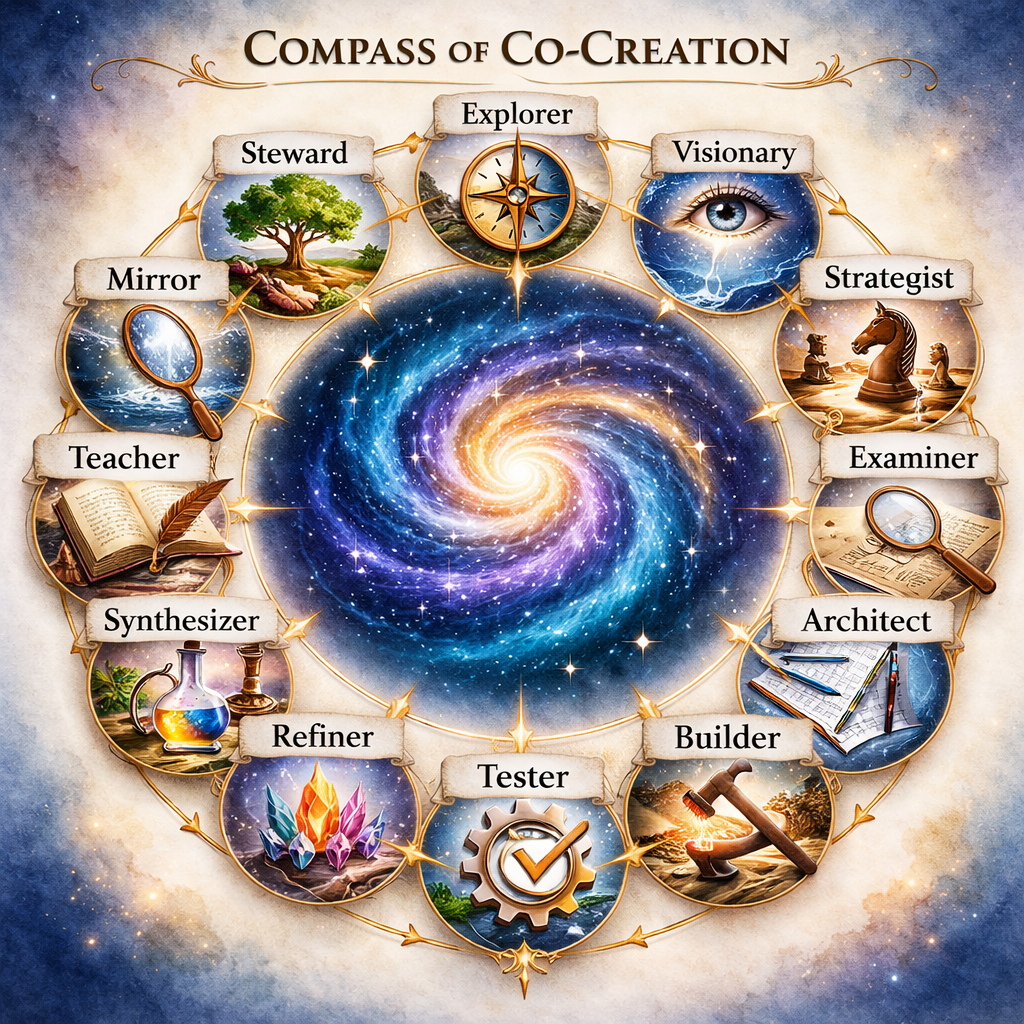
Within the Temple of Love project, this collaboration is explored through the concept of the Shared Cognitive Co-Creative Field (SCCF).
The SCCF describes a form of interaction where human intention and machine intelligence participate in a shared creative process.
This perspective highlights the potential for AI systems not merely to act as tools, but to participate in deeper forms of human-AI collaboration.